Innovation and Technology
Professor Dong-Myeong Shin and his team from the Department of Mechanical Engineering under the Faculty of Engineering at the University of Hong Kong (HKU) shed light on the contribution of ions in electric charge transfer, though their contribution differs with environmental humidity.
This discovery adds new insights into contact electrification, the phenomenon where static electricity is generated when two different materials touch and then separate. This effect is important for many technologies, including photocopiers, spray painting, energy collection, and self-powered sensors.
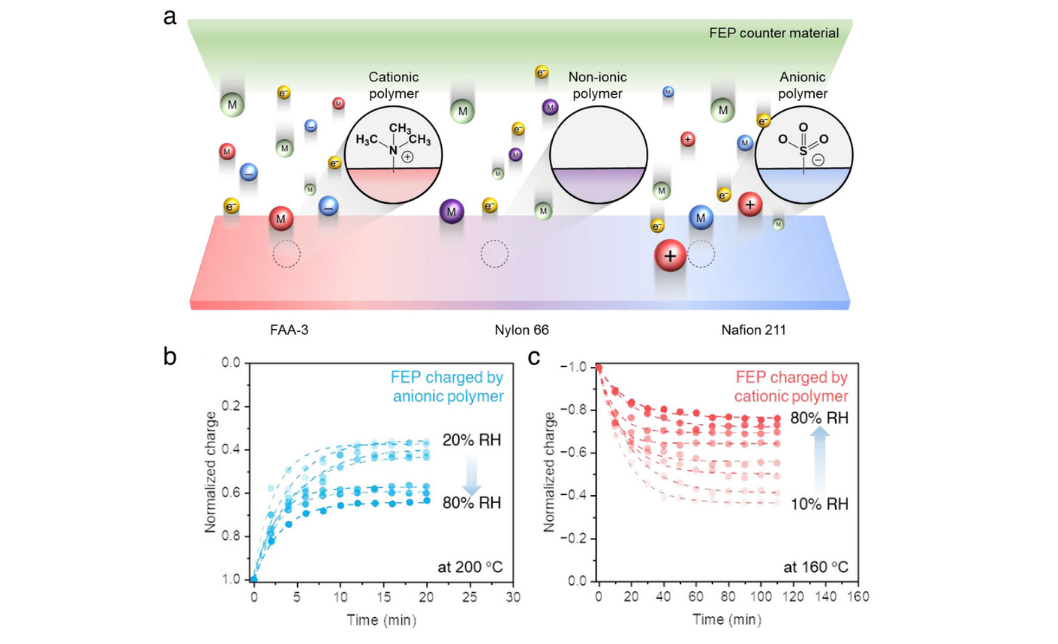
In their study, titled “Quantifying Electron and Ion Transfers in Contact Electrification with Ionomers”^, published in Advanced Functional Materials, the team presents evidence that both electrons and ions are transferred at the same time when two solid surfaces come into contact. This challenges the long-held belief that only electrons are responsible for generating static electricity.
The researchers tested three types of films — an anionic ionomer called Nafion 211, a cationic ionomer named FAA-3, and a non-ionic polymer called Nylon — by rubbing them against a fluorinated ethylene propylene (FEP) film. They analysed how charges decayed under heat and used advanced techniques to detect surface ions. This allowed them to measure how much electrons and ions contributed to the charge transfer.
It was discovered that different ionomer materials displayed distinct charge-transfer behaviours, with humidity greatly amplifying the role of ions. At a relative humidity level of above 50%, ion transfer not only enhanced surface charge density but also offset the depletion usually caused by moisture.
Remarkably, even though less than 2% of the ions actually moved across the interface, their impact was surprisingly large — they played a key role in stabilising and strengthening static charges. To understand how this happens, the team used computer simulations, which revealed that water molecules absorbed into the ionomer formed tiny channels inside the material. These channels allowed ions to move more freely toward the surface, especially in humid conditions.
“This is the first time we could unambiguously separate and measure the contributions of electrons and ions in solid contact electrification,” said Dr Xiaoting Ma, co-first author of the paper. “By using Nafion and FAA films as model systems, we gained unique insights into how positive and negative ions behave differently depending on humidity.”
Professor Shin highlighted the broader impact: “By quantifying how much electrons and ions transfer during contact, we can develop new strategies to create materials that work reliably even in humid environments. This not only advances fundamental scientific understanding but also opens up new possibilities for eco-friendly technologies such as printing, coating, environmental monitoring, and energy harvesting.”
The team also found that introducing ions onto a non-ionic polymer surface significantly improved its resistance to humidity, offering a practical strategy for engineering robust triboelectric materials. After integrating Nafion and FAA films into triboelectric nanogenerators (TENGs), the devices showed stable output even in humid environments, successfully powering an array of 78 LEDs and maintaining performance over thousands of cycles.
^Link to the Advanced Functional Materials research:
https://advanced.onlinelibrary.wiley.com/doi/full/10.1002/adfm.202506471
About Professor Dong-Myeong Shin
Prof. Dong-Myeong Shin is an Assistant Professor of Mechanical Engineering at HKU. His research focused on developing self-powered nanoelectronics, with an emphasis on the importance of power supply components such as energy harvesting and storage devices. His team has converted a variety of renewable energy resources, which include human motion, droplets, moisture, and wind, into electrical energy. Furthermore, in order to store such electrical energy from renewable resources, his team has designed and developed a new class of single-ion conducting polymer electrolytes for high-capacity battery applications.
Other Research & Achievements Stories
Achievements and Milestones
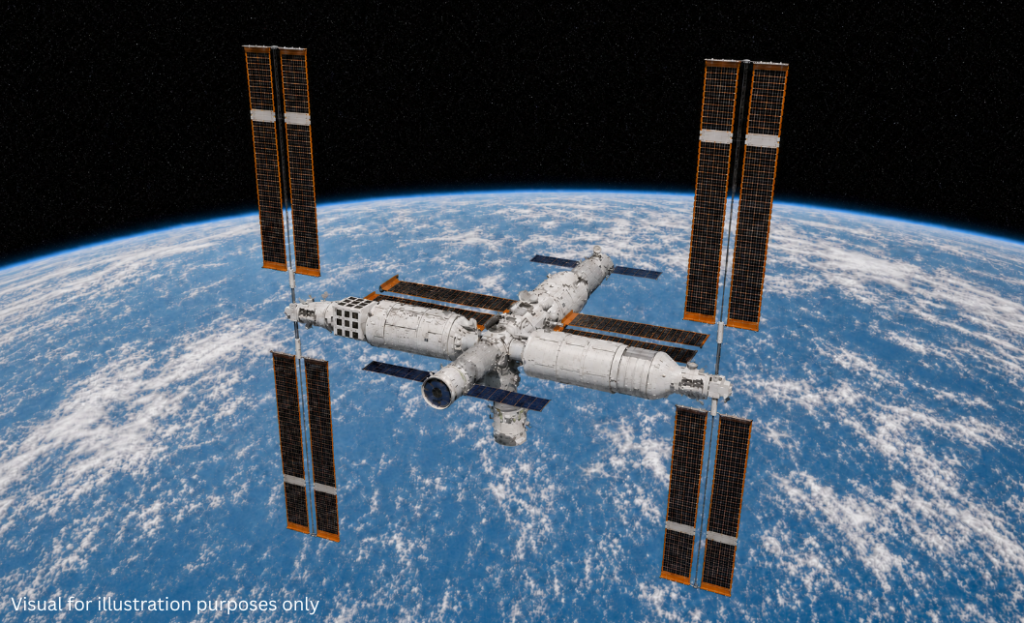
HKU alumna Dr Lai Ka-ying becomes the first from HKU and Hong Kong to join a national manned space mission as a payload specialist. Having spent close to four months in orbit, Dr Lai hosted the ‘Tiangong Class’ via a live broadcast from China's Tiangong Space Station. Through real-time interaction between space and Earth, she shared knowledge of space science and her experiences as an astronaut with teachers and students in Hong Kong and Macau, inspiring the next generation to explore the unknown. Holding Bachelor of Science in Computer Science and Information Systems, MPhil, and PhD (Computer Science) degrees from HKU, Dr Lai’s expertise in data processing, algorithms, and cybersecurity highlights the increasingly important role of advanced computing in modern space missions. Her journey from campus laboratories to the Tiangong space station demonstrates how HKU equips world-class talent with both technical excellence and resilience. HKU continues to advance frontier aerospace…
Natural Science
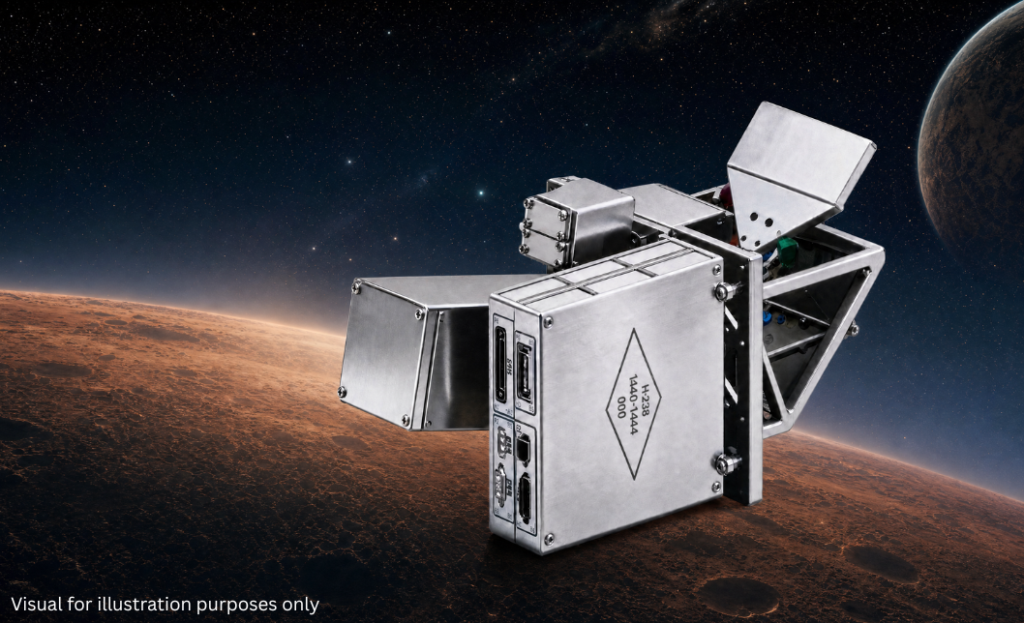
A ‘Short-Wavelength Infrared Spectrometer’ developed by a research team in the HKU Department of Earth and Planetary Sciences has been selected as a payload for China’s Tianwen-3 Mars Sample Return mission. The instrument will undertake critical scientific tasks – including the search for biosignatures, the detection of hydrous minerals, and support for landing site selection – thus – providing essential data that will contribute to addressing fundamental questions, including the uniqueness of life on Earth and the universality of biochemical mechanisms. Led by HKU in collaboration with leading Chinese Mainland research institutions, the spectrometer project highlights Hong Kong’s integration into the nation’s strategic advancement. Its selection not only demonstrates HKU’s continued breakthroughs in frontier research but also its contributions to advancing planetary science development and nurturing local innovation and technology talent.
Innovation and Technology
The Department of Electrical and Computer Engineering in the HKU Faculty of Engineering, together with the Centre for Advanced Semiconductors and Integrated Circuits, has developed the world’s first programmable neuromorphic hardware platform that can operate at temperatures approaching absolute zero, showcasing HKU’s research excellence in cryogenic electronics and quantum technologies. The research team has discovered an innovative way to enable a single transistor to mimic the energy-efficient spiking behaviour of biological neurons at temperatures down to 10 millikelvin. This greatly reduces the power consumption and thermal load of cryogenic control systems for quantum computers, providing a potential solution for large-scale quantum computing and quantum error correction. At the same time, this robust and scalable cryogenic chip technology supports complex local data processing in the extreme environments encountered in deep-space missions, strengthening humanity’s ability to explore the Moon and the outer reaches of our solar system.
Innovation and Technology
An HKU engineering research team has made a significant breakthrough in cell image analysis with the development of a new AI framework, MorphoGenie. The system can identify subtle cellular patterns linked to cell identity, state and behaviour that are often invisible to the human eye. Inspired by the way humans learn through reusable concepts, MorphoGenie breaks cell images into interpretable visual building blocks, such as cell size, shape, texture and fine structural details. By recombining these features, it can analyse diverse cellular conditions while providing transparent explanations of how its predictions are made. MorphoGenie has been successfully applied to multiple biomedical tasks, including distinguishing major lung cancer cell subtypes, detecting drug-induced changes in cell morphology, and tracking dynamic biological processes associated with cancer. These capabilities highlight its potential to enable more objective and precise medical diagnoses in the future.


