Natural Science
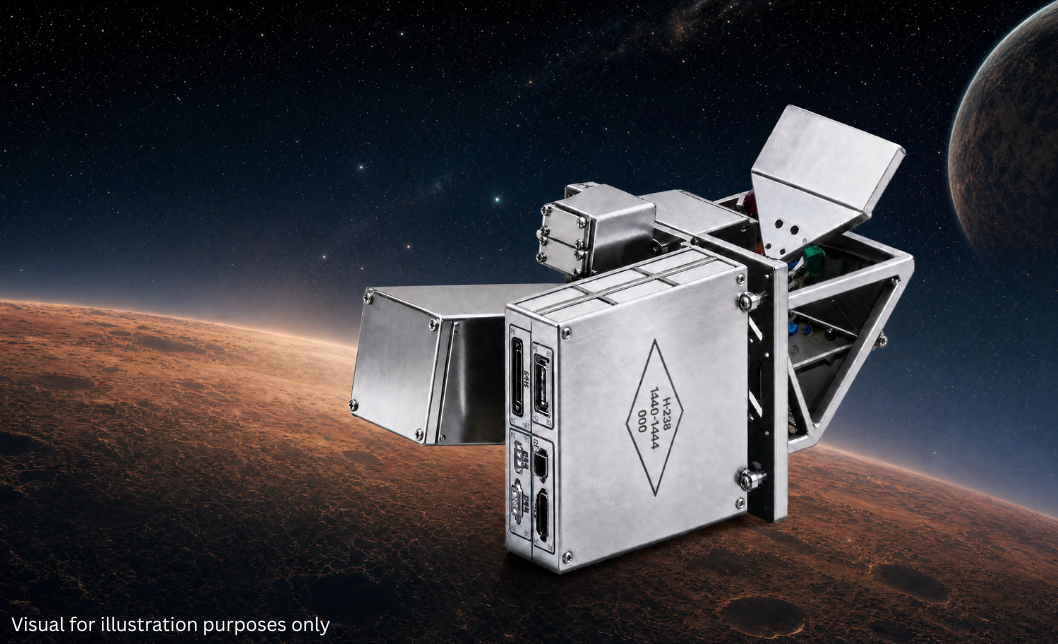
A research team from the Department of Earth and Planetary Sciences at The University of Hong Kong (HKU) will participate in China’s planetary exploration mission, Tianwen-3. According to the selection results released by the China National Space Administration recently, the ‘Short-Wavelength Infrared Spectrometer’, led and developed by HKU, has been officially chosen as a payload for deployment on the service module of the Tianwen-3 mission. The instrument will play a critical role in forecasting dust storms during landing manoeuvres, searching for biosignatures, detecting hydrous minerals, and surveying Martian resources.
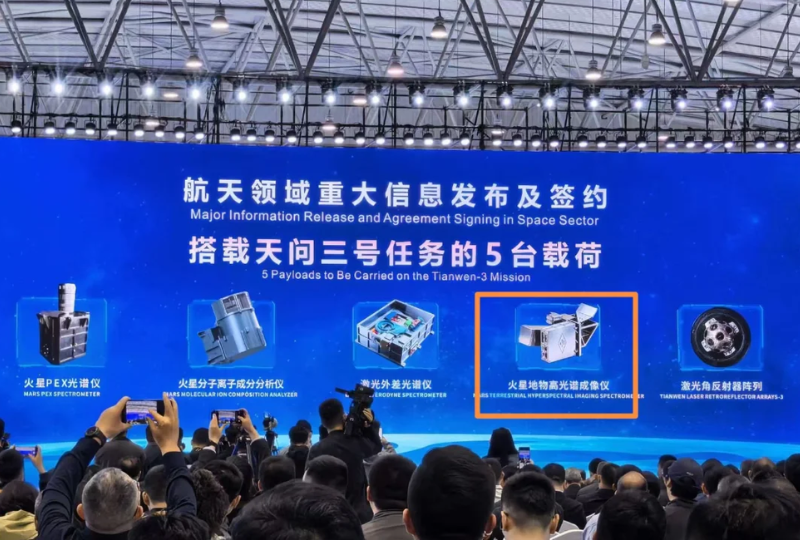
Tianwen-3 mission is China’s first Mars Sample Return mission. Scheduled for launch in 2028, with sample return planned for 2031, the mission aims to address fundamental scientific questions, including the uniqueness of life on Earth and the universality of biochemical mechanisms in the universe.
Professor Xiang Zhang, President and Vice-Chancellor of HKU, commented, “HKU is honoured to participate in the Tianwen-3 planetary exploration mission. The selection of our research project as a mission payload reflects the University’s deep-seated expertise in planetary science and deep-space exploration, while marking a significant contribution to the nation’s strategic advancement as a leading space power. We remain committed to deepening our frontier research to further expand the boundaries of human knowledge.”
The project is led by Professor Yiliang LI of the Department of Earth and Planetary Sciences at HKU, with major collaborating institutions including Zhejiang University and the Chinese Academy of Sciences’ Changchun Institute of Optics, Fine Mechanics, and Physics.
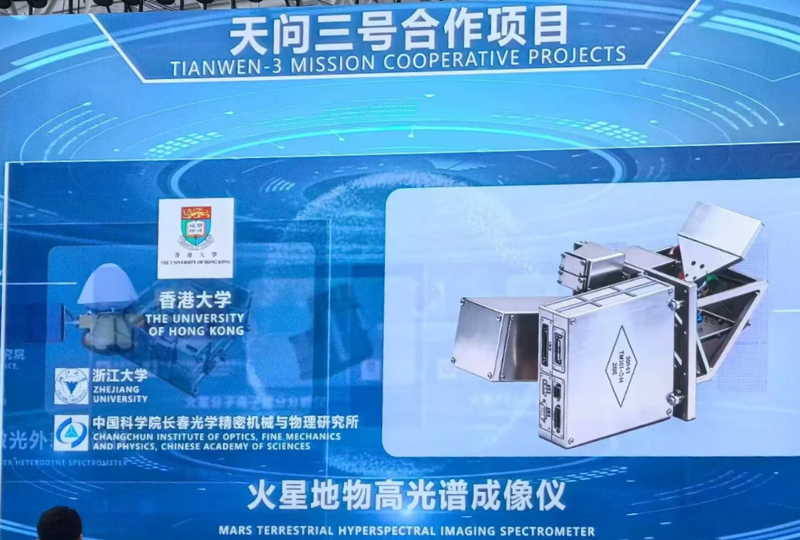
The orbital spectrometer will undertake three primary tasks:
Professor Li stated, “This mission marks a significant contribution from Hong Kong’s scientific community to the nation’s deep space exploration programme. Using hyperspectral imaging technology, we will directly search for biosignatures and hydrous minerals on Mars, which is fundamentally important for understanding the distribution of life in the universe.”
Professor Li has served as a core member of both the Landing Site Selection Team and the Mission Science Team of Tianwen-3 mission. The selection of this payload demonstrates HKU’s international competitiveness in Earth and planetary sciences while fostering interdisciplinary synergy across science and engineering in Hong Kong.
Professor Li further noted that the project aligns with two concurrent developments, “First, the continued expansion of HKU’s research capabilities in Earth and planetary sciences, particularly in cosmochemistry and astrobiology focusing on solar system bodies such as asteroids, Mars and Jupiter; and second, the Hong Kong SAR Government’s strategic initiative to cultivate a local aerospace industry, by leveraging the region’s geographical advantages.”
Other Research & Achievements Stories
Achievements and Milestones
The University of Hong Kong celebrated the opening of Phase II of the HKU Zhangjiang Base in Shanghai, marking a major milestone in its Shanghai strategy. The new facilities strengthen HKU’s research, education and innovative presence in the Yangtze River Delta, offering state-of-the-art laboratories, teaching spaces and student facilities. Addressing the event, HKU President and Vice-Chancellor Professor Xiang Zhang highlighted the University’s commitment to integrating research, education and industry collaboration to nurture future-ready talent. Shortly after opening, the HKU Zhangjiang Base welcomed more than 500 students from around the world for the new academic year, offering hands-on research opportunities closely aligned with industry needs and supporting the development of a full-chain innovation ecosystem that combines research, education, and industrialisation.

Achievements and Milestones
The HKU Talent Forum and the Second Anniversary Celebration of the HKU Techno-Entrepreneurship Academy (TEA) in Qianhai brought together leaders from government, academia, industry and innovation sectors to discuss talent development and entrepreneurship in the AI era. HKU President and Vice-Chancellor Professor Xiang Zhang emphasised that universities should develop character, capability and wisdom, noting that asking the right questions is more important than simply accessing knowledge. Speakers highlighted the need to use AI as a tool while preserving human judgement and values. The event also celebrated TEA’s achievements in nurturing cross-border innovation, supporting 100 incubated projects and attracting significant investment, while strengthening Hong Kong-Shenzhen collaboration in research, talent, and entrepreneurship.
Achievements and Milestones
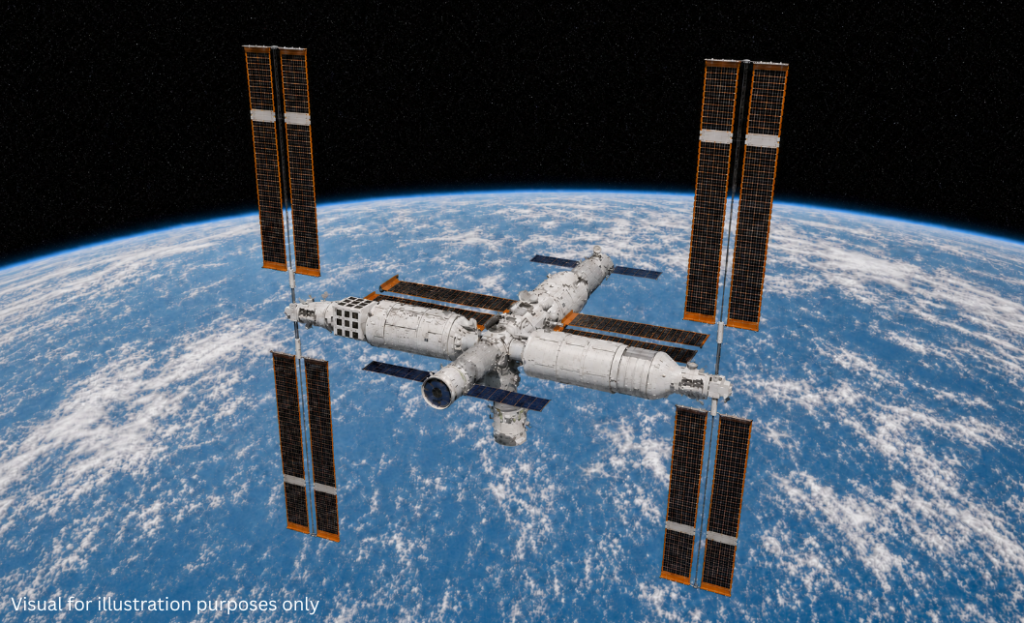
HKU alumna Dr Lai Ka-ying becomes the first from HKU and Hong Kong to join a national manned space mission as a payload specialist. Having spent close to four months in orbit, Dr Lai hosted the ‘Tiangong Class’ via a live broadcast from China's Tiangong Space Station. Through real-time interaction between space and Earth, she shared knowledge of space science and her experiences as an astronaut with teachers and students in Hong Kong and Macau, inspiring the next generation to explore the unknown. Holding Bachelor of Science in Computer Science and Information Systems, MPhil, and PhD (Computer Science) degrees from HKU, Dr Lai’s expertise in data processing, algorithms, and cybersecurity highlights the increasingly important role of advanced computing in modern space missions. Her journey from campus laboratories to the Tiangong space station demonstrates how HKU equips world-class talent with both technical excellence and resilience. HKU continues to advance frontier aerospace…
Innovation and Technology
The Department of Electrical and Computer Engineering in the HKU Faculty of Engineering, together with the Centre for Advanced Semiconductors and Integrated Circuits, has developed the world’s first programmable neuromorphic hardware platform that can operate at temperatures approaching absolute zero, showcasing HKU’s research excellence in cryogenic electronics and quantum technologies. The research team has discovered an innovative way to enable a single transistor to mimic the energy-efficient spiking behaviour of biological neurons at temperatures down to 10 millikelvin. This greatly reduces the power consumption and thermal load of cryogenic control systems for quantum computers, providing a potential solution for large-scale quantum computing and quantum error correction. At the same time, this robust and scalable cryogenic chip technology supports complex local data processing in the extreme environments encountered in deep-space missions, strengthening humanity’s ability to explore the Moon and the outer reaches of our solar system.


