Innovation and Technology
Researchers from Department of Electrical and Computer Engineering under the Faculty of Engineering at the University of Hong Kong (HKU) and the Centre for Advanced Semiconductors and Integrated Circuits (CASIC), have achieved a major breakthrough in cryogenic electronics. The team have developed a programmable neuromorphic hardware platform that operates near absolute zero, providing a potential solution for scaling up quantum computers and enabling deep-space exploration.
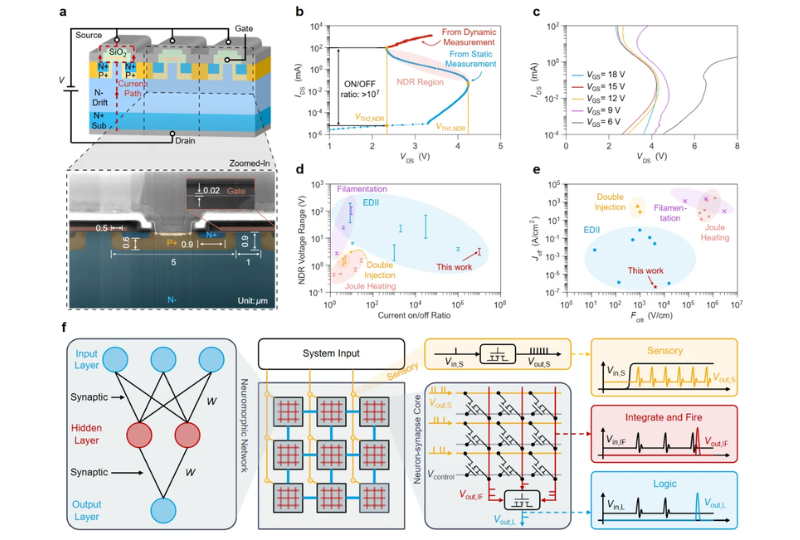
NDR in SiC MOSFETs and their applications in spiking neuromorphic circuits
Led by Professor Yuhao Zhang and PhD student Xin Yang, the team has discovered an innovative way to generate and control negative differential resistance (NDR) in industry-standard Silicon Carbide (SiC) MOSFETs. For the first time, they have demonstrated that a single transistor can mimic the energy-efficient ‘spiking’ behavior of biological neurons at temperatures as low as 10mK.
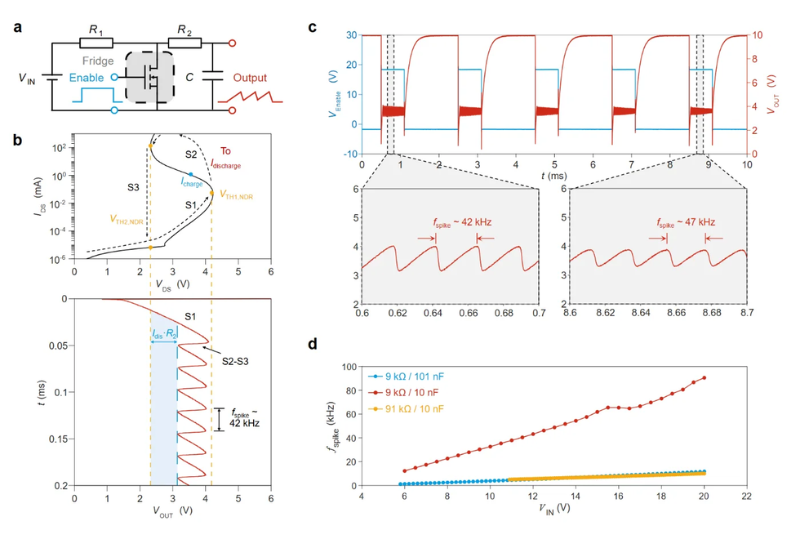
NDR-based sensory neuron
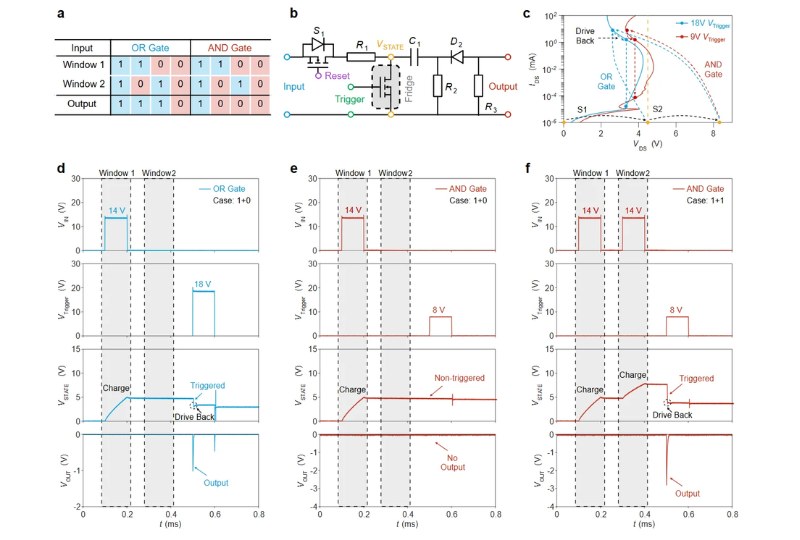 NDR-based spiking logic neuron
Modern quantum computers rely on complex electronics to control qubits, which are extremely sensitive and must be maintained at millikelvin temperatures. Current silicon-based controllers generate excessive heat and consume high levels of power, forcing them to be placed far from the qubits. This separation creates a wiring bottleneck that limits the scalability and performance of quantum systems.
“Our work introduces a hardware platform that can be integrated alongside quantum processors,” said Professor Zhang. “By using the unique carrier dynamics in silicon carbide, we can create circuits that are thousands of times more energy-efficient than conventional electronics, significantly reducing the thermal load on cryogenic systems”.
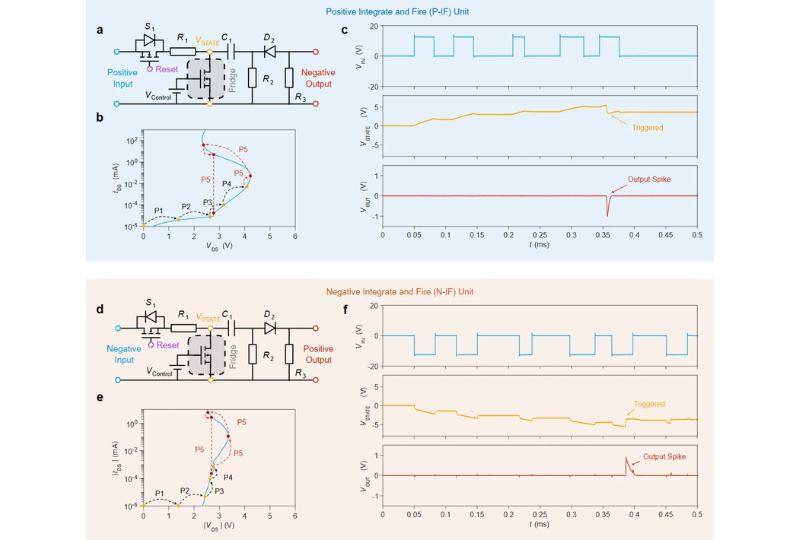
NDR-based integrate-and-fire neurons with positive and negative types
The researchers discovered that when SiC MOSFETs are cooled below 2K, they exhibit a potent ‘S-shape’ NDR behavior fueled by electron-donor impact ionization (EDII). Unlike existing technologies that rely on heat to function, this mechanism is intrinsic to the material’s atomic structure, making it exceptionally stable and repeatable across different manufacturing batches.
“This is a robust and scalable approach,” said Mr Yang. “Because SiC is already used globally in electric vehicles and power grids, we can leverage existing industrial foundries to manufacture these cryogenic chips on 300-mm wafers”.
The study proves that these neurons can be ‘cascaded’ to form larger networks, paving the way for complex, local data processing at cryogenic temperatures. This technology is expected to enhance the performance of quantum error correction and real-time quantum control.
Beyond quantum computing, these rugged circuits are ideal for deep-space exploration, where electronics must survive the extreme cold of the lunar surface or the outer reaches of our solar system.
The discovery has been published in Nature Communications in an article titled “Cryogenic neuromorphic circuits using gate-controlled negative differential resistance in silicon carbide”.
The article is available at: https://www.nature.com/articles/s41467-026-70963-6
About Professor Yuhao Zhang
Professor Yuhao Zhang is currently a full professor with the Department of Electrical and Computer Engineering of the University of Hong Kong (HKU). He also serves as the Associate Director of the HKU Centre for Advanced Semiconductors and Integrated Circuits. Before joining HKU, he was the Shirish S. Sathaye Associate Professor with Virginia Tech, leading the power semiconductor research at the Center for Power Electronics Systems, the largest academic research center in power electronics in the U.S. He received his PhD and S. M., both in electrical engineering from Massachusetts Institute of Technology (MIT) in 2017 and 2013, respectively. He has authored over 200 papers and 2 book chapters and holds 9 granted U. S. patents. He is a co-author of over 10 highlight/feature/prize papers. His work has been cited over 13,000 times with a h-index of 60 and been widely covered by Nature Electronics, Semiconductor Today, Compound Semiconductors, EE Times, etc. over 100 times.
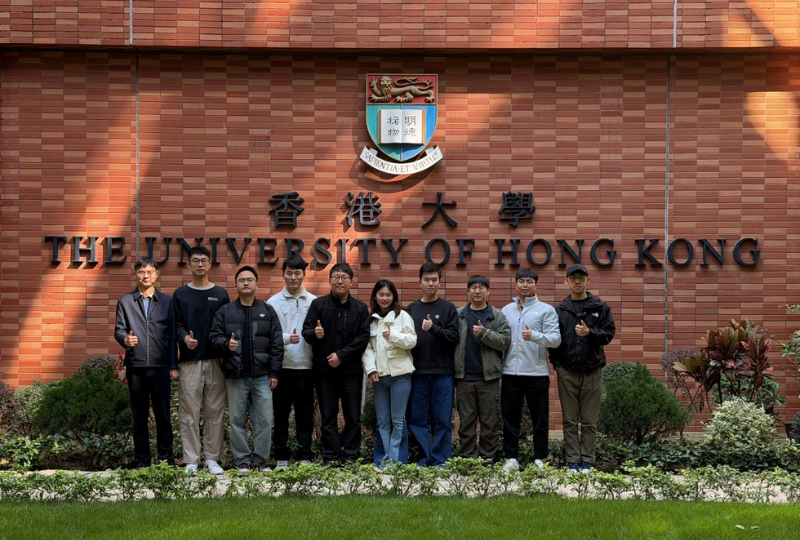
He currently serves as the Chair of the Power Devices and ICs Technical Committee of the IEEE Electron Device Society, an Associate Editor-in-Chief for IEEE Electron Device Letters, an Associate Editor for IEEE Transactions on Power Electronics, and the TPC member of many conferences (e.g., IEDM, APEC, WiPDA). He received the MIT Microsystems Technology Laboratories Doctoral Dissertation Award, two IEEE George Smith Awards (best paper award of the year in IEEE Electron Device Letters), four Technical Highlights of IEEE International Electron Devices Meeting (IEDM), IEEE William M. Portnoy 1st Prize Paper Award, the National Science Foundation CAREER Award, the Faculty Fellow Award of Virginia Tech, the Office of Naval Research Young Investigator Award, the Compound Semiconductor Week Young Scientist Award, and the He Xiang Jian Young Scientist Award.
Other Research & Achievements Stories
Achievements and Milestones
The University of Hong Kong celebrated the opening of Phase II of the HKU Zhangjiang Base in Shanghai, marking a major milestone in its Shanghai strategy. The new facilities strengthen HKU’s research, education and innovative presence in the Yangtze River Delta, offering state-of-the-art laboratories, teaching spaces and student facilities. Addressing the event, HKU President and Vice-Chancellor Professor Xiang Zhang highlighted the University’s commitment to integrating research, education and industry collaboration to nurture future-ready talent. Shortly after opening, the HKU Zhangjiang Base welcomed more than 500 students from around the world for the new academic year, offering hands-on research opportunities closely aligned with industry needs and supporting the development of a full-chain innovation ecosystem that combines research, education, and industrialisation.

Achievements and Milestones
The HKU Talent Forum and the Second Anniversary Celebration of the HKU Techno-Entrepreneurship Academy (TEA) in Qianhai brought together leaders from government, academia, industry and innovation sectors to discuss talent development and entrepreneurship in the AI era. HKU President and Vice-Chancellor Professor Xiang Zhang emphasised that universities should develop character, capability and wisdom, noting that asking the right questions is more important than simply accessing knowledge. Speakers highlighted the need to use AI as a tool while preserving human judgement and values. The event also celebrated TEA’s achievements in nurturing cross-border innovation, supporting 100 incubated projects and attracting significant investment, while strengthening Hong Kong-Shenzhen collaboration in research, talent, and entrepreneurship.

Achievements and Milestones
HKU alumna Dr Lai Ka-ying becomes the first from HKU and Hong Kong to join a national manned space mission as a payload specialist. Having spent close to four months in orbit, Dr Lai hosted the ‘Tiangong Class’ via a live broadcast from China's Tiangong Space Station. Through real-time interaction between space and Earth, she shared knowledge of space science and her experiences as an astronaut with teachers and students in Hong Kong and Macau, inspiring the next generation to explore the unknown. Holding Bachelor of Science in Computer Science and Information Systems, MPhil, and PhD (Computer Science) degrees from HKU, Dr Lai’s expertise in data processing, algorithms, and cybersecurity highlights the increasingly important role of advanced computing in modern space missions. Her journey from campus laboratories to the Tiangong space station demonstrates how HKU equips world-class talent with both technical excellence and resilience. HKU continues to advance frontier aerospace…
Natural Science
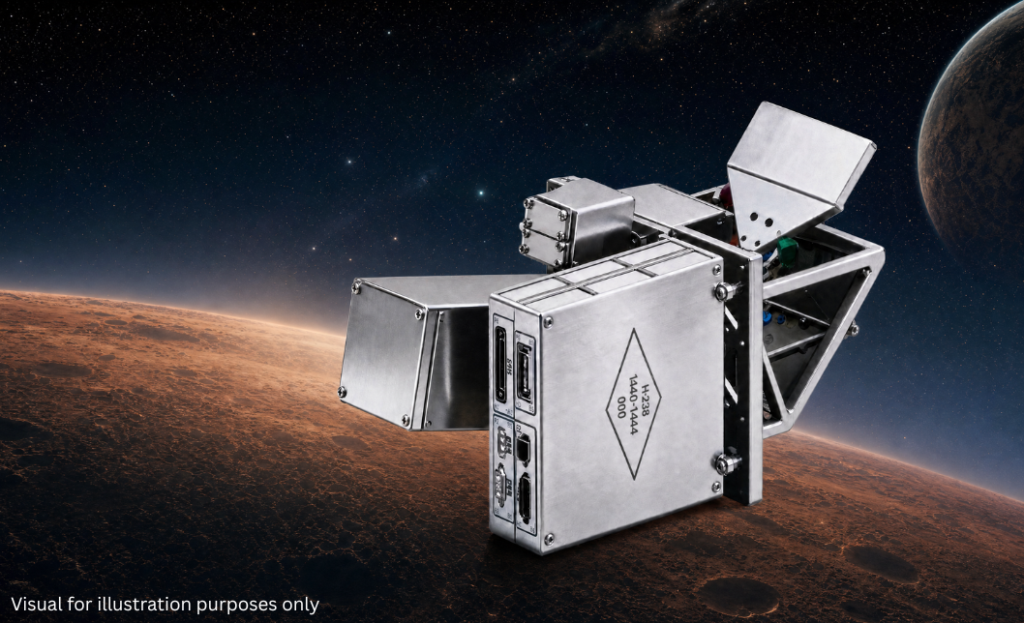
A ‘Short-Wavelength Infrared Spectrometer’ developed by a research team in the HKU Department of Earth and Planetary Sciences has been selected as a payload for China’s Tianwen-3 Mars Sample Return mission. The instrument will undertake critical scientific tasks – including the search for biosignatures, the detection of hydrous minerals, and support for landing site selection – thus – providing essential data that will contribute to addressing fundamental questions, including the uniqueness of life on Earth and the universality of biochemical mechanisms. Led by HKU in collaboration with leading Chinese Mainland research institutions, the spectrometer project highlights Hong Kong’s integration into the nation’s strategic advancement. Its selection not only demonstrates HKU’s continued breakthroughs in frontier research but also its contributions to advancing planetary science development and nurturing local innovation and technology talent.


